
search site
BIBLE BOOK: JOEL
More than a Plague of Locusts…..
The last twelve books in the Old Testament are known as “the Minor Prophets” and follow on from Isaiah, Jeremiah, Ezekiel, and Daniel. These books written by the four “Major Prophets” are considerably longer. “Minor Prophets” therefore does not suggest unimportance but simply signifies that their writings were shorter in length. In the Hebrew Bible they are referred to as “The Twelve”. Joel is the second of them, and his prophecy is probably not very well known today.
The name Joel means “the LORD (Jehovah) is God”. He is identified as “the son of Pethuel” (Joel 1:1) whose name means “vision of God”. Nothing more than this is known of Joel or, for that matter, of his father Pethuel. In those days the credentials of a prophet were important, and Joel’s heritage must have been a necessary inclusion in the short prophecy, identifying him as a messenger of God.
By using a concordance one can discover four other men by the name of Joel mentioned elsewhere in the Old Testament (1). By examining the context, however, it is evident that these individuals have nothing to do with the prophet we are considering. What can we say about the author of this short Old Testament book?
THE BACKGROUND
Although we might like to know when Joel ministered, it is not possible to be certain. Bible commentators offer different suggestions, some placing him earlier and others later in history. The subject matter found in his book is really all we have to help us determine when he lived, and it does seem quite likely that Joel was one of the earliest of the Old Testament prophets. Some consider that he was a contemporary of Elisha, but this cannot be proved with absolute certainty. The references to Judah and Jerusalem (3:6) suggest that Joel was a prophet to Judah (the southern kingdom) rather than to Israel (the northern kingdom). The closing verses of the book refer to Egypt and Edom (3:19) which both troubled Judah during the reign of Jehoram – as described in 2 Chronicles 21. It is therefore likely that Joel ministered a little more than 800 years before Christ.
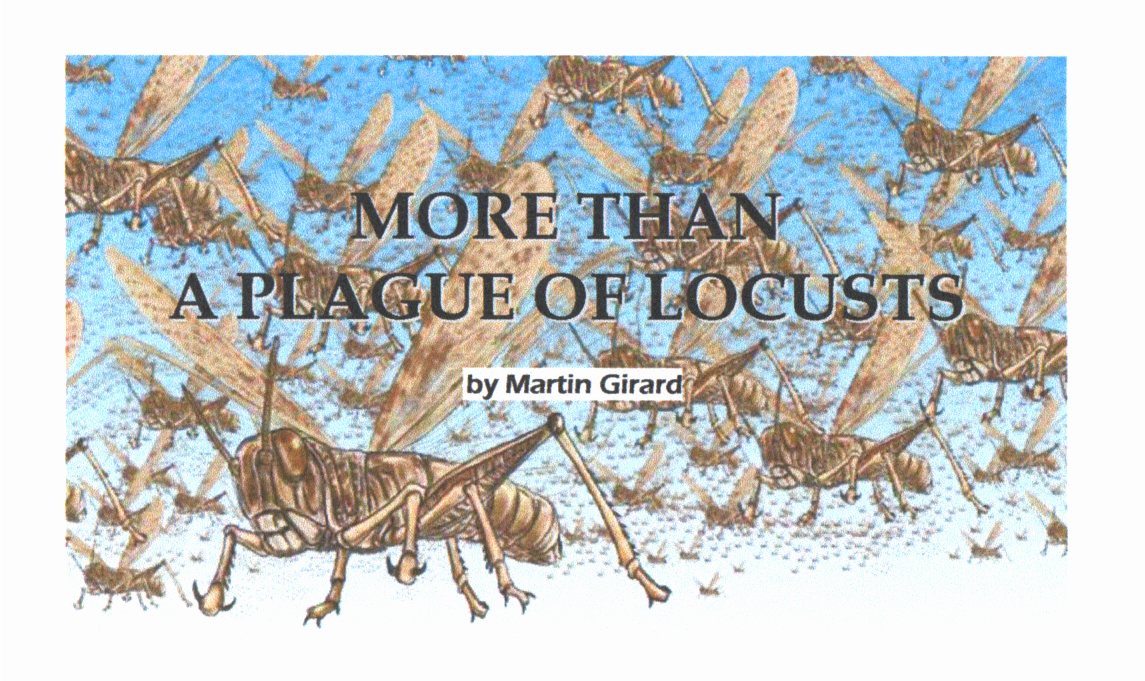
The opening verses of the book set the scene. The prophet had a vision of an enormous plague of locusts, sent as a judgment from God, destroying the crops. But the locusts portrayed something far worse, for they foreshadowed an even more severe judgment to be faced in “the day of the LORD” (1:15). It was a convincing warning to the nation of the need to repent of its sin.
THE PROPHET’S MESSAGE
We can divide the book of Joel into two parts. The first section relates to the days of Joel and to the prospect facing his people at the time, while the second section takes us on into the future. “A plague of locusts” can be a veritable scourge and can do untold damage to a community or a nation. Those who have witnessed them tell of how they can fill the sky and blot out the light of the sun as they approach, before marching like well-disciplined soldiers across the land, consuming everything before them.
The “plague of locusts” sent into Egypt centuries earlier (Ex.10:3-15) had caused utter devastation and would never be forgotten. One generation would have impressed upon the next the severity of that plague, but the locusts described by Joel seem to have been even worse. The “old men” were addressed by the prophet and were asked, “Hath this been in your days, or even in the days of your fathers?” (Joel 1:2). One generation would tell the next not just of one kind of locust but of a number of types consuming absolutely everything (1:3,4). Resembling those locusts, a lion-like nation would invade and strip the land of all its wealth (1:6,7).
The expressions “lament” (1:8), “be ye ashamed” (1:11), and “howl” (1:13) prepare the way for the call to repentance. The land of Judah was under the judgment of God because of the sin of its people. It was time for them to turn to the LORD with contrite hearts, pleading with Him for mercy, and asking Him to hold back the punishment which they deserved (2:12-14). “Who knoweth?” Joel asked (2:14). God is a merciful God, and He might be prepared to spare His guilty people once again.
The future, however, is not utterly hopeless. The prophet’s message becomes one of promise with the words, “Then will the LORD be jealous for His land” (2:18). Showing pity to His people, He would send “corn, and wine, and oil” making them “satisfied” (2:19) and would turn the menacing “northern army” away from the land (2:20). The note of assurance is strong, positive, and heartening: “Be glad then, ye children of Zion, and rejoice in the LORD your God” (2:23). He would undo the damage that had been caused and “restore” to His people “the years that the locust hath eaten” (2:25).
“THE DAY OF THE LORD”
Although part of Joel’s message concerned the present condition of his people, future events are also an important theme in the book. Any present judgment, whether experienced or anticipated, was a foreshadowing of “the Day of the LORD” which is a significant prophetic event mentioned in many places in the Old Testament. It will be a time of unparallelled darkness (3:15) when “the heavens and the earth shall shake” (3:16), and the nations are gathered into “the valley of Jehoshaphat” (3:2) for the battle of Armageddon (mentioned in Revelation 16:16). This will take place just before the return of Christ to this earth to deal with His enemies and to bring in His Millennial kingdom.
Initially it will be necessary for the implements of agriculture to be modified to become the instruments of war (3:10) as the nations assemble to fight, but later the opposite will happen. There will come a time when “they shall beat their swords into plowshares, and their spears into pruninghooks: nation shall not lift up sword against nation, neither shall they learn war any more (Isa.2:4). The Millennium will be a time of peace and prosperity, pictured in the mountains dropping new wine, and the hills flowing with milk (Joel 3:18). God’s Spirit will be poured out upon all flesh (2:28), and unsurpassed blessings will be known. In that future day “Judah shall dwell for ever, and Jerusalem from generation to generation” (3:20). What a time that will be!
APPLICATIONS NOW
On the Day of Pentecost, when the Church was born, Peter preached to the people of Jerusalem and applied verses in Joel 2 to the outpouring of the Holy Spirit. Although Joel 2:28-32 has not been fulfilled in its entirety yet, Peter could see a valid partial fulfilment in the coming of the Holy Spirit. He quoted from Joel’s prophecy as he issued his gospel appeal, “Whosoever shall call on the name of the Lord shall be saved” (Acts 2:21). What Peter did, demonstrates how Scripture can be applied legitimately. Although a certain book may not be written about us, it can still have applications which may relate to us. Practical lessons of this kind can be drawn out from the book of Joel.
The words “I will restore to you the years that the locust hath eaten” (2:25) have often encouraged a child of God. Looking back over a wasted life, and regretting all kinds of lost opportunities, a humble and repentant soul can be assured that a gracious God can restore and open up new paths for fruitful service in future days. Just as Peter quoted from Joel in his preaching, it is possible to relate the message of Joel to the gospel in our day. “Multitudes, multitudes in the valley of decision” (3:14) reminds the evangelist of the millions of souls who are uncommitted and need to make that decision and receive Christ as their personal Saviour. The words “turn unto the LORD your God” (2:13) can be applied to the message of the gospel and the call to repentance.
Although Joel may be called a “minor prophet”, major themes can be found in his short book. In a brief article like this it has barely been possible to scratch the surface. Much more can be found that will bring spiritual profit to our lives. We need to read the book carefully, identifying the reasons for its existence. At the same time we must recognize its place in God’s inspired Word and the potential it has for speaking directly to our hearts today.
END NOTES:- (1) See 1 Sam. 8:2; 1 Chr.5:8; 11:38; 15:7,11.